Dec 15, 2025
The Trello Alternative That Goes Beyond Boards: Why Teams Switch to Pivot for Project Management and Collaboration
 Jennifer Simonazzi
A marketing team launches a new campaign, and the first instinct is to spin up a Trello board. Cards fill quickly: draft copy here, design requests there, deadlines hidden inside checklists that only a few teammates remember to open. As assets move along, approvals don’t happen in the cards themselves but in Slack threads or email chains, where decisions vanish into the noise. What started as a neat Kanban view now feels like a split screen between the board and half a dozen other apps.
Trello works for a while, especially when a project is small and the team is tight-knit. But once a campaign involves multiple departments, recurring goals, and external collaborators, the platform begins to feel stretched. Conversations detach from the tasks they’re meant to support, and progress updates scatter across channels that no longer point back to the same work. The very project management tools meant to simplify the workflow instead leave teams juggling tabs to piece together context.
That is the moment many start looking for a Trello alternative, not to replace every process at once, but to find a team collaboration app and project planning tool where tasks, communication, and goals can exist side by side. The need is less about chasing efficiency and more about building a system that grows with the work instead of leaving it fragmented.
The Limits of Trello: What Pushes Teams Toward a Trello Alternative
What begins as a clean board with cards for tasks can, over time, grow into something far more difficult to manage. The very simplicity that makes Trello appealing at first is also what holds teams back once campaigns expand, projects span departments, or external collaborators step in. Instead of moving in one rhythm, the work begins to sprawl, and the platform requires patches, plugins, and external tools just to stay afloat.
The most common frustrations include:
Boards collapsing under the weight of large campaigns, with endless cards and lists that are difficult to prioritize.
Conversations fragmenting as card comments prove too shallow to hold real discussions, forcing teams into Slack, email, or external chats.
Dependencies, long-term planning, and goal-setting requiring additional plugins, each with its own cost and learning curve.
Power-Ups and integrations quickly multiplying, adding cost and technical overhead that small teams rarely anticipate.
Reporting dashboards providing only surface-level information, which drives managers back to spreadsheets for anything deeper.
For many teams, these patterns signal the need for a Trello alternative, not because the platform fails entirely, but because they’ve outgrown what a card-based system alone can provide. When campaigns demand more than just a board view, organizations start looking for a project management app that combines task tracking tools with communication and planning features that keep pace with a remote team app built for real collaboration.

Meet Pivot: Beyond a Board, A Complete Structure
Choosing a Trello alternative often comes down to the moment a team realizes that moving cards across columns cannot hold the full weight of a campaign, a course, or a client engagement. Trello works well as a starting point, but the gaps begin to show once conversations drift into Slack, assets hide in Google Drive, and updates slip away into endless threads. Pivot approaches this differently, not as a collection of boards, but as a layered environment where every project is anchored by a goal block that ties the work together.
At its core, Pivot gives you three building layers that go beyond what most project management tools provide:
Spaces act as containers for projects, communities, or clients. Within a space, you can create one goal for a focused initiative or multiple goals for a larger program. The goal’s description becomes a living brief, holding the “why” and “how” of the work.
Rooms bring together async posts, live chat, audio, video, and streaming, so discussion happens in context and can easily be referenced or summarized back on the goal.
Blocks carry the daily weight of work: databases, canvases, events, and most importantly, goals. A goal block is more than a heading on a board: it sets the project’s scope, lets you switch between board, list, calendar, and timeline views, and keeps progress connected to outcomes. Even the comment thread can be toggled open when you need context or closed when you just want to focus on the plan.
For startups launching campaigns, agencies managing clients, educators running courses, or creators building communities, Pivot provides not just task tracking but a single narrative for the entire project. The goal block becomes the spine of that narrative, holding priorities, cycles, and decisions in one place so work and conversation remain inseparable.

Teams evaluating a Trello alternative often realize that a board with cards and checklists is not enough to manage the scale, pace, or complexity of their projects. Trello earns its reputation for simplicity, but as campaigns stretch across departments, clients, and partners, that simplicity starts turning into friction. Pivot answers those limits with a structure anchored by goal blocks, where tasks, context, and progress are all tied to a single source of truth.
Here’s how the comparison plays out in practice:
Boards and Flexibility
Trello: Boards and lists provide a starting point, but managing dependencies or shifting timelines usually requires multiple Power-Ups and manual setup.
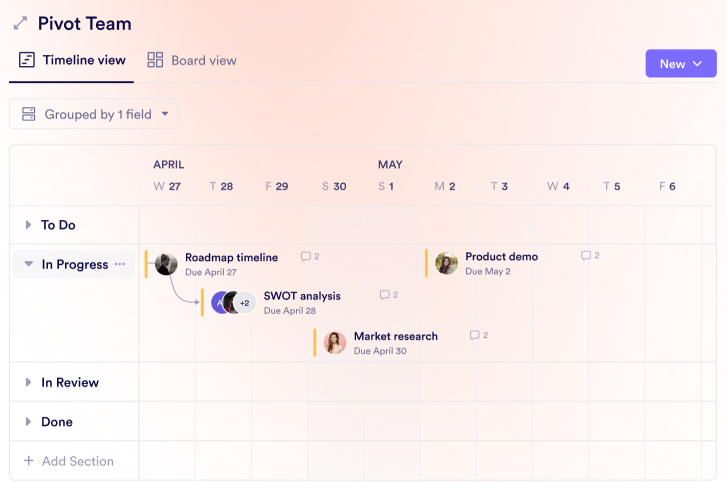
Pivot: Goals serve as the foundation for every project. Each goal comes with multiple views—board, list, calendar, timeline—so you can switch perspectives without losing context. Tasks live inside the goal itself, directly connected to the project’s outcomes.
Communication and Context
Trello: Comments live on cards, making deeper discussions spill over into Slack threads, emails, or meetings.
Pivot: Rooms keep async posts, chat, audio, video, and even streams tied back to the goal. When you revisit the goal later, you can open the comment toggle to see every decision made, or collapse it to focus purely on execution.
Permissions and Collaboration
Trello: Roles are basic and often limited, especially when working with contractors or external stakeholders.
Pivot: Space-level roles and goal-specific access make it easy to decide who can view, edit, or comment. You can invite outside collaborators without exposing unrelated work, giving clients or partners a clear window into progress.
Planning and Visibility
Trello: Dependencies, milestones, and priorities usually require separate boards or custom plugins.
Pivot: A single goal can hold cycles, milestones, and sub-goals, all visible in one description. This turns your project into a narrative where progress is tracked against what really matters—not just moving cards across columns.
Reporting and Analytics
Trello: Dashboards and reporting rely on additional Power-Ups and manual exports.
Pivot: Analytics are built in and tied to goals, showing you completion rates, overdue items, and cycle health in real time.
When teams compare Trello against Pivot, the difference is clear: Trello organizes tasks, while Pivot organizes the entire project. The goal block ensures that tasks, discussions, and outcomes stay connected from kickoff to completion.
Step-by-Step: Setting Up Pivot as a Trello Alternative for Project Planning
Switching to Pivot doesn’t require a full reset. The best way to get started is to create a dedicated space for one campaign, client, or internal project, then make that space the single home for every task, discussion, and decision that follows.
A smooth rollout often looks like this:
Create a Space
Give your project its own space so everything lives under one roof. This is where goals, rooms, and databases will connect, making it easy for the team to find updates and stay aligned. Read more on this on our blog A Microsoft Teams Alternative That Handles More Than Chat: Why Switch to Pivot for Unified Collaboration, Projects, and Docs.
Add a Goal Block as Your Project Anchor
Inside the space, create a goal block to act as the central source of truth. Write a strong description so everyone understands the purpose and success criteria. Break the goal down into cycles, add milestones, and connect tasks so the team always knows what’s next.
Mirror Existing Boards and Tasks
Recreate your Trello boards by adding tasks under the goal. Switch between board, list, and timeline views to match how your team already works, but keep everything connected to the goal so context never gets lost.
Layer in Communication
Open a post room in the same space to handle updates, reviews, and approvals. Because comments can be toggled open or closed, your team can focus on tasks when needed, then revisit the full history without leaving the page.
Onboard Your Team and Iterate Invite team members with role-based permissions, then assign tasks from the goal block so priorities are clear. As your team gets comfortable, start adding more goals, databases, and events until Pivot becomes the central hub for every project.
By starting with a space and anchoring it with a goal, teams move from a flat task board to a living project environment where planning, communication, and execution happen in one place. This gradual approach lets you adopt Pivot without disrupting existing workflows, and turns every project into a clear, measurable path forward.
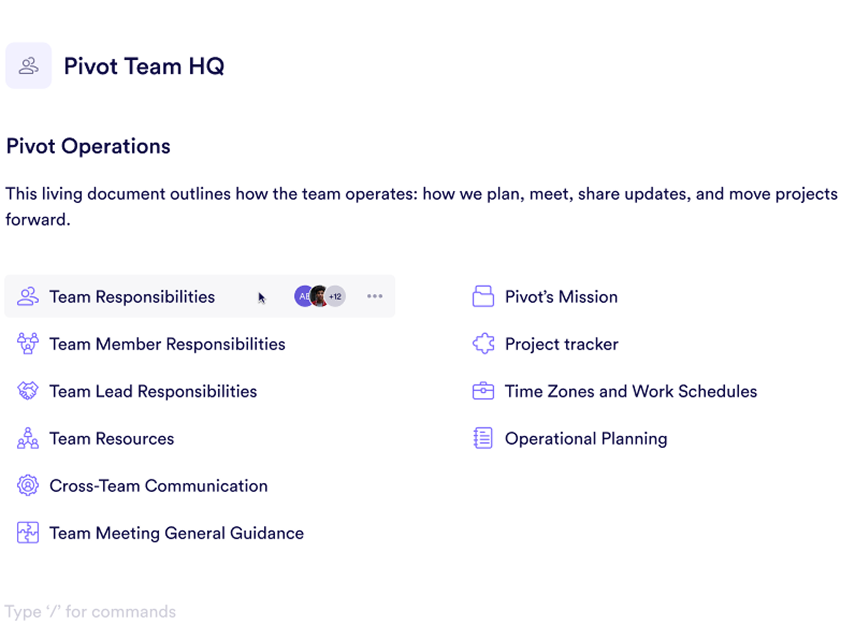
The rhythm of work shifts dramatically once teams move from simple task boards to a space anchored by a goal. Instead of scattered lists and disconnected chats, the work gains a shared narrative: every discussion, update, and decision tying back to what the team is ultimately trying to achieve.
Content teams: Campaigns start with a goal that defines the outcome. That could range from publishing a set of articles to launching a full brand campaign. Writers attach drafts directly to tasks under the goal, designers upload assets in the same database, and editors toggle comments open or closed to review in context. Approvals and next steps are tracked against the goal itself, so no one is chasing status updates across Slack threads or buried emails.
Course creators: Each cohort or program becomes a goal inside a space, holding lessons, assignments, and live events under one roof. Submissions are linked to the goal’s progress, and instructors can measure completion rates at a glance. Discussions stay in rooms tied to the goal, making it easy for students to keep learning asynchronously between sessions.
Marketing directors: Goals become campaign dashboards. Instead of exporting data into spreadsheets, they filter tasks, deadlines, and blockers inside the goal view itself. Built-in analytics show which tasks are lagging, which contributors are overloaded, and where the team is ahead.
Pivot turns a Trello-style board into a living project environment where teams not only track tasks but also see how every action contributes to the bigger picture. The result is less juggling between tools and more forward motion on the work that matters.
FAQs About Pivot as a Trello Alternative
Can Pivot replace Trello boards for task management, or does it work differently? Pivot supports boards and lists, but also adds goals, databases, and calendars that tie tasks directly to goals, making it more adaptable for complex projects than Trello’s card-based layout.
How does Pivot handle project planning compared to Trello’s boards and checklists? While Trello boards often stop at visual task tracking, Pivot lets you create layered project planning tools with goals and linked databases so deadlines, ownership, and outcomes stay visible together.
Does Pivot support async collaboration tools natively, or would my team still need Slack or Zoom? Pivot includes post rooms for threaded updates, chat for real-time discussion, and audio/video rooms for meetings or office hours, so teams can work asynchronously or live without leaving the project.
How are permissions different in Pivot compared to Trello’s boards? Trello boards use simple roles, which can feel limiting when clients or external contributors are added. Pivot allows role-based access at the space level, so you can invite contractors, students, or members into projects with precise control.
Can Pivot serve as a community platform in ways Trello cannot? Yes. Teams, educators, and creators often use Pivot as both a project management app and a community building app, hosting events, posts, and discussions in the same environment where work happens.
Does Pivot integrate with content creation workflows? Yes. Files, briefs, drafts, and reviews live in database blocks or post rooms, making Pivot usable as a content creation app where feedback and publishing tasks move together instead of living across multiple tools.
Join Pivot: One Trello Alternative That Moves Work Forward With Fewer Steps
Teams that once stretched Trello boards across campaigns, clients, and content calendars often find themselves looking for project planning tools that keep more than checklists in view. Pivot does not demand that you abandon your existing project management app immediately. Instead, it opens a space where task management, communication, and shared goals coexist without relying on extra apps to fill the gaps. By combining boards, databases, rooms, and goal tracking, Pivot functions as a team collaboration app that works just as well for remote teams as it does for agencies, educators, and creators.

Jennifer Simonazzi
Content Writer
Share this post
Table of Contents
Subscribe to never miss out on updates and inspiration
Watch new Pivot tutorials, attend live training sessions, and get access to exclusive new features.
